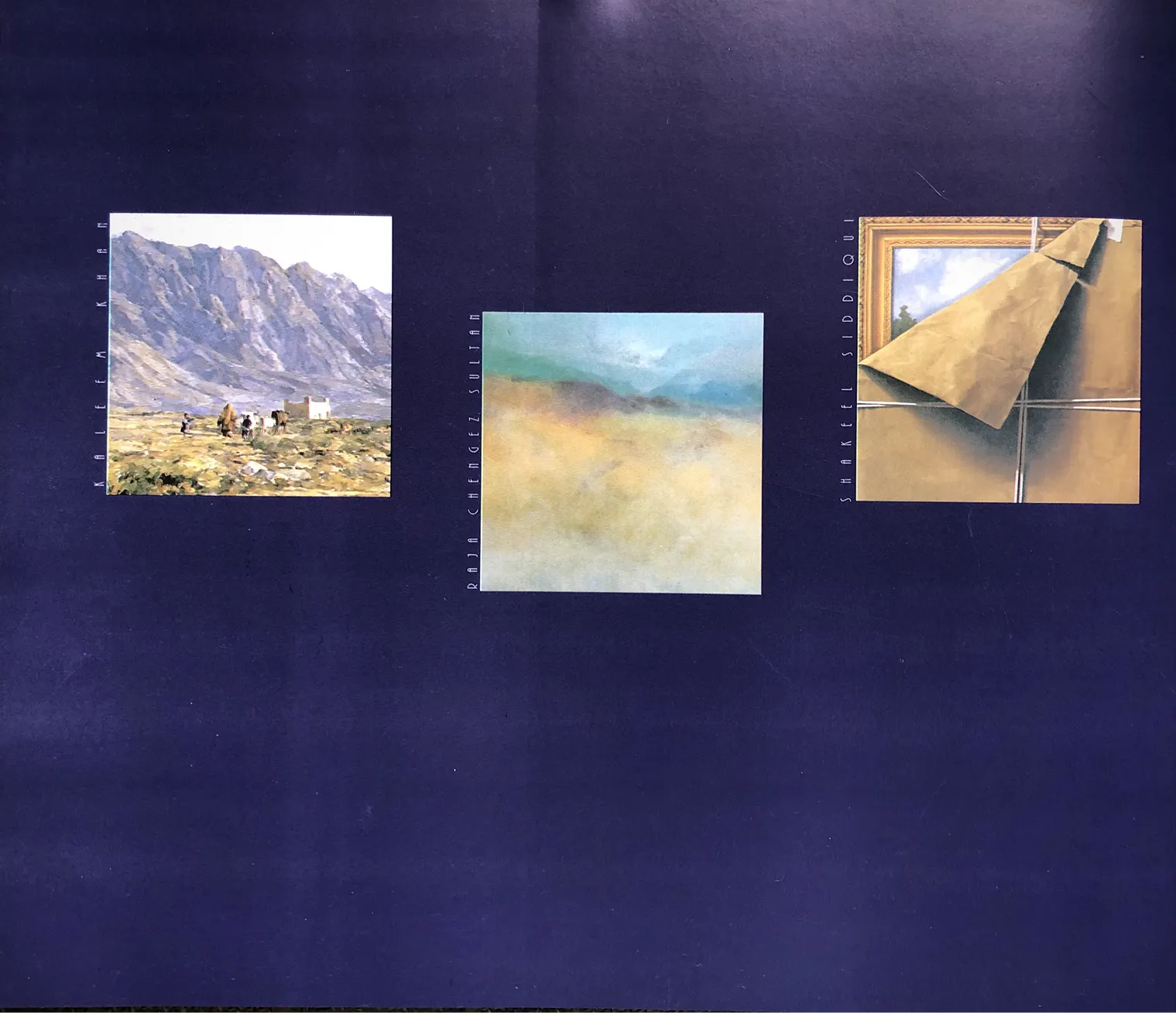
Uraan Exhibition
2002
Publisher: Zenaini Gallery
Editor: Sairah Irshad Khan
Designer: Sabiha Mohammed Imani
Uraan Exhibition
2002
Publisher: Zenaini Gallery
Editor: Sairah Irshad Khan
Designer: Sabiha Mohammed Imani
The catalogue covers the work of 33 participating artists that ranged from masters to mid-career artists in the Uraan (Flight) exhibition. Its curatorial concept underlined Flight as an emblem of change that was integral to the dynamic art scene of Pakistan.
Catalogue Preface
By Niilofur Farrukh
Uraan (flight) in this exhibition serves as an emblem of the spirit of change that imbed the creative mind in nascent Pakistan. This radical
break from the traditionalism of the day had been inspired by the
liberating philosophy of the poet Iqbal. His verses equated personal empowerment with the flight of shaheen, the regal bird, whose grand ideals could guide man to self determine his destiny.
Iqbal’s stimulating poetry awakened the mind and spirit to take the creative leap and discover sitaroon si agay jehan or the uncharted universe of ideas birthed by the synthesis of tradition and modernity. Caught in the moribund conventions of the New Bengal School, the artist/thinker felt a new idiom would be better suited to capture the ethos of the changing times and subsequently looked at ‘The School of Paris’ for inspiration. Artists adopted this as early as 1945 in Calcutta and later in Bombay in 1947; this new trend in Modernism was introduced in Pakistan via avant-garde painters of East Pakistan like Zainul Abedin and The Lahore Art Circle. A ground- breaking event in this direction was the first solo of modernist paintings by Zubeida Agha that gave impetus to this idiom in Pakistan.
EXHIBITION VIEW
contribution to catalogues
The catalogue has been especially designed by Sabiha Imani to preserve the visual memory of the show. All the four sections of the show are highlighted with a bilingual contextual note.
2025
In the interview , Meher Afroz discusses the metaphysical experience , which is central to the show. Also highlighted is her process of transforming symbols to convey the quest for spiritual truth.
2012
The article maps the two distinct trajectories of the art practice of Amin Gulgee’s. His formal calligraphic sculpture and figurative iconography in metal and the experimental performances and installations that are time based and ephemeral.
2007
The article underlines how Amin Gulgee has been looking for the perfect balance between his formal sculptures and the spontaneous and asymmetrical creativity of his performative work, and impermanent installations.
2011
The article mapped the discursive sessions with artists, art critics and curators during the ArtFest Karachi.
2021
Postcolonial Theory explains how the concept of a ‘subaltern culture ‘ was built on the false assumption that, as Edward Saeed puts it ‘ the East was not capable of composing their own narrative’.
2010
As calligraphy changed from a symbol of identity to a component of a subversive strategy , its assimilation in visual arts continues to evolve
2006
‘Painting miniature is like expressing yourself in Urdu’ Imran Qureshi , the leading miniaturist tells Niilofur.
2000
Uraan (Flight) in this exhibition serves as an emblem of the spirit of change that imbued the creative mind in nascent Pakistan.
2002
Text for the catalogue of the show curated by Amin Gulgee and Sheherebano Hussain. The show addressed the nation’s ambivalent relationship with the representation of the body/ figure in visual culture.
2006
The catalogue covered the sixteen exhibitions held for the inaugural of the National Art Gallery Islamabad.
2007
Niilofur as its curatorial lead , described the project as a moving caravan that brought together over 200 artists to pay tribute to the memory of Zahoorul Akhlaq, Pakistan ‘s major artist who became a victim of violent crime. The artists worked on the Takhti , the wooden tablet that was used by the late artist.
2001
The catalogue covered the sixteen exhibitions held for the inaugural of the National Art Gallery Islamabad.
2007
Text for the catalogue of the show curated by Amin Gulgee and Sheherebano Hussain. The show addressed the nation’s ambivalent relationship with the representation of the body/ figure in visual culture.
2006
‘Painting miniature is like expressing yourself in Urdu’ Imran Qureshi , the leading miniaturist tells Niilofur.
2000
As calligraphy changed from a symbol of identity to a component of a subversive strategy , its assimilation in visual arts continues to evolve
2006
In the interview , Meher Afroz discusses the metaphysical experience , which is central to the show. Also highlighted is her process of transforming symbols to convey the quest for spiritual truth.
2012
Postcolonial Theory explains how the concept of a ‘subaltern culture ‘ was built on the false assumption that, as Edward Saeed puts it ‘ the East was not capable of composing their own narrative’.
2010
The article mapped the discursive sessions with artists, art critics and curators during the ArtFest Karachi.
2021
The article underlines how Amin Gulgee has been looking for the perfect balance between his formal sculptures and the spontaneous and asymmetrical creativity of his performative work, and impermanent installations.
2011
The article maps the two distinct trajectories of the art practice of Amin Gulgee’s. His formal calligraphic sculpture and figurative iconography in metal and the experimental performances and installations that are time based and ephemeral.
2007